
Abstract
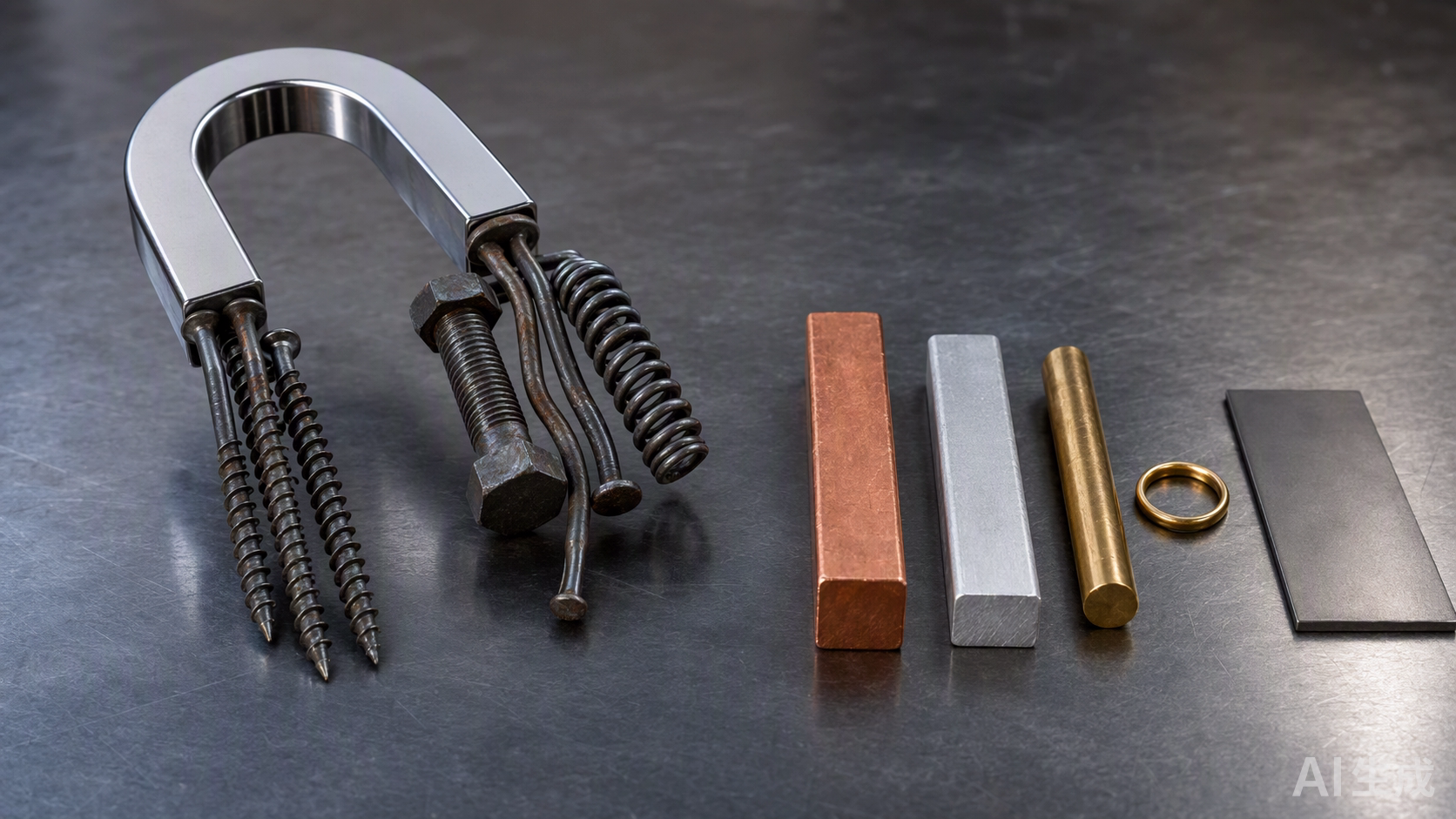
This article explains the difference between magnetic metals and non-magnetic metals. It describes why only a few metals are strongly magnetic, lists clear examples of each group, and shows where these materials are used in daily life and in manufacturing. The paper is written in plain language. Short sentences are used so that a reader in middle school can follow the ideas. The main finding is simple. Only iron, nickel, cobalt and a small number of their alloys are strongly magnetic at room temperature. Most other metals, including copper, aluminium, brass, gold and silver, are not. Some metals sit in a grey area, where the answer depends on temperature or on how the metal was processed. This is why a magnet test alone cannot always identify a metal.
1. Introduction
Magnets are part of modern life. They hold notes on a refrigerator door. They sit inside every loudspeaker, every electric motor and every computer hard drive. Hospitals use very strong magnets to look inside the human body. Yet most people believe that “all metal sticks to a magnet.” This is not true, and the mistake causes real problems in workshops, recycling plants and laboratories.
The difference matters for practical reasons. A factory that sorts scrap metal needs to know which metals a magnet will pick up. A machine shop must decide whether a magnetic clamp can hold a part. A surgeon needs tools that will not move inside an MRI scanner. A jeweller must choose a metal that will not set off a security gate. In each case, the question is the same: is this metal magnetic or non-magnetic?
This paper answers that question in four steps. Section 2 explains what causes magnetism in a metal. Section 3 lists magnetic metals. Section 4 lists non-magnetic metals. Section 5 discusses the confusing cases, where the simple answer fails. Section 6 describes how to test a metal, and Section 7 covers real applications. Section 8 explains why this topic is important in machining and metalworking.
2. What Makes a Metal Magnetic?
2.1 Electrons behave like tiny magnets
All matter is made of atoms. Inside an atom, electrons move around the nucleus in levels called shells. Each electron acts like a very small spinning ball with two magnetic poles. Scientists call this property spin. Because of spin, every electron is like a tiny magnet.
Electrons usually live in pairs. When two electrons share the same space, one spins up and the other spins down. Their magnetic effects cancel each other out. This is why water, wood and plastic are not magnetic. Their electrons are all paired.
Some atoms, however, have unpaired electrons. These unpaired electrons do not have a partner to cancel them. Their tiny magnetic effects remain active. Iron, nickel and cobalt all have unpaired electrons in their outer shells. This is the first requirement for strong magnetism.
2.2 Domains: why a nail is not always a magnet
Unpaired electrons are not enough on their own. If they were, every iron object would be a magnet. Consider an ordinary iron nail. It is full of unpaired electrons, but it does not attract anything until it is magnetised.
The reason is a structure called a magnetic domain. Inside a piece of iron, billions of atomic magnets group together into small regions. In each region, all the atomic magnets point the same way. These regions are the domains. In an unmagnetised nail, the domains point in random directions. One domain pulls north, another pulls south, and the effects cancel.
When you place the nail near a strong magnet, the domains that already point the right way grow larger. Others rotate to line up. Now most domains agree, and the nail becomes a temporary magnet. Some nails keep this alignment after the magnet is removed. Those become permanent magnets. Soft iron loses its alignment almost at once, which makes it useful inside transformers and electromagnets.

2.3 Three kinds of magnetic behaviour
Physicists divide materials into three groups. The first two groups are so weak that you cannot feel them.
Ferromagnetic materials are strongly attracted to a magnet. The prefix “ferro” comes from ferrum, the Latin word for iron. These materials can become permanent magnets. Only a handful of metals behave this way at room temperature.
Paramagnetic materials are attracted very weakly. Aluminium and platinum belong here. A normal magnet will not pick them up. The force is real, but you need a sensitive balance to measure it. Paramagnetic materials also cannot hold magnetism once the external field is removed.
Diamagnetic materials are pushed away very weakly. Copper, silver, gold, lead and bismuth are diamagnetic. The effect is tiny in most metals. Bismuth is the exception: it is strongly enough diamagnetic that a thick piece can be made to float above a row of powerful magnets.
A useful summary is this. In everyday speech, “magnetic metal” means ferromagnetic metal. Everything else is called non-magnetic, even though physics says the truth is more subtle.
3. Magnetic Metals
Strong magnetism in pure metals is rare. There are only four well-known examples near room temperature.
3.1 Iron (Fe)
Iron is the classic magnetic metal. It is also the cheapest and most common one. About 95 percent of all metal produced worldwide is iron or steel. Every carbon steel, every cast iron and most alloy steels are magnetic, because they contain a structure built from iron atoms.
Iron loses its ferromagnetism above 770 °C, a point called the Curie temperature. If you heat a steel bar to orange-red heat and bring a magnet near it, the magnet will no longer hold it. This effect is used in blacksmithing and in heat treatment.
3.2 Nickel (Ni)
Nickel is the second magnetic metal most people meet. It is silvery, hard and resistant to rust. Nickel plating is common on keys, taps and fasteners. Many coins contain nickel, which is why a strong magnet can grip some coin denominations. Nickel’s Curie temperature is about 358 °C.
Because nickel is magnetic, nickel-containing alloys can be magnetic too. Monel, an alloy of about two-thirds nickel and one-third copper, is attracted to a magnet even though both pure copper and pure nickel-based marine fittings are often assumed to be non-magnetic.
3.3 Cobalt (Co)
Cobalt is the third magnetic metal, and it has the highest Curie temperature of the three, about 1121 °C. This makes cobalt valuable where heat matters. Cobalt alloys keep their magnetism at temperatures that would destroy an ordinary magnet. Cobalt is also used in hard cutting tools, in wear-resistant coatings and in lithium-ion battery cathodes.
3.4 Gadolinium (Gd) and the rare earths
Gadolinium is a rare-earth metal that is ferromagnetic near room temperature. Its Curie temperature is only about 20 °C, so it is magnetic in a cold room and barely magnetic in a warm hand. Some other rare earths, such as terbium and dysprosium, order magnetically only at very low temperatures. These metals are laboratory and industrial curiosities rather than workshop materials.
3.5 Magnetic alloys and engineering materials
Most useful magnets are not pure metals. They are alloys or compounds.
| Material | Main elements | Notes |
|---|---|---|
| Carbon steel | Iron + carbon | Magnetic in all normal conditions |
| Cast iron | Iron + carbon + silicon | Magnetic; used for machine bases |
| Tool steel | Iron + tungsten, chromium, vanadium | Magnetic |
| Ferritic stainless (430) | Iron + chromium | Magnetic |
| Martensitic stainless (410, 420) | Iron + chromium + carbon | Magnetic and hardenable |
| Alnico | Aluminium + nickel + cobalt + iron | Classic permanent magnet, heat resistant |
| Neodymium magnet (NdFeB) | Neodymium + iron + boron | Strongest common permanent magnet |
| Samarium-cobalt (SmCo) | Samarium + cobalt | Keeps strength at high temperature |
| Mumetal / permalloy | Nickel + iron | Very soft magnetism, used for shielding |
A common question is whether a neodymium magnet is magnetic. It obviously is, but the reason is worth stating: it contains a large amount of iron. The neodymium supplies a crystal structure that holds the alignment firmly. Most high-strength magnets are iron-based in this way.
4. Non-Magnetic Metals
The majority of metals on the periodic table are non-magnetic for practical purposes. Some are paramagnetic and some are diamagnetic, but neither group responds to a hand magnet.

| Metal | Composition | Physical class | Typical uses |
|---|---|---|---|
| Aluminium | Al (often with Cu, Mg, Zn) | Paramagnetic | Aircraft, cans, frames, heat sinks |
| Copper | Cu | Diamagnetic | Wiring, bus bars, plumbing |
| Brass | Cu + Zn | Diamagnetic | Fittings, musical instruments, bearings |
| Bronze | Cu + Sn | Diamagnetic | Bushings, propellers, sculptures |
| Gold | Au | Diamagnetic | Jewellery, electronics contacts |
| Silver | Ag | Diamagnetic | Contacts, solder, jewellery |
| Titanium | Ti (often Ti-6Al-4V) | Paramagnetic | Implants, aerospace, race hardware |
| Lead | Pb | Diamagnetic | Weights, shielding, battery plates |
| Zinc | Zn | Diamagnetic | Plating, die casting, batteries |
| Tin | Sn | Diamagnetic | Solder, plate, bronze alloying |
| Magnesium | Mg | Paramagnetic | Lightweight cast housings |
| Tungsten | W | Paramagnetic | Electrodes, counterweights, drill bodies |
| Platinum | Pt | Paramagnetic | Catalysts, laboratory crucibles |
| Austenitic stainless (304, 316) | Fe + Cr + Ni | Effectively non-magnetic | Food plant, marine, medical |
4.1 The aluminium and copper group
Aluminium and copper are the two most important non-magnetic engineering metals. Both conduct electricity well. Both are light compared with steel. Neither will ever be picked up by a magnet. Copper is diamagnetic and aluminium is paramagnetic, so a strong neodymium magnet held against either of them does nothing visible.
There is one dramatic exception, and it is a motion effect rather than an attraction. Drop a strong neodymium magnet down a vertical copper or aluminium pipe. It falls slowly, as if moving through honey. The moving magnet creates circulating currents in the pipe wall. These eddy currents produce their own magnetic field that opposes the motion. Nothing is magnetic in the ordinary sense, yet the magnet is clearly slowed. This same principle drives eddy-current brakes on roller coasters and freight trains.
4.2 The noble metals
Gold, silver and platinum are all non-magnetic. This fact is used in testing. A cheap gold-plated ring that is strongly attracted to a magnet reveals a ferrous core. Genuine 14k and 18k gold will not stick. Silver has a slightly darker tone and does tarnish magnetically neutral, so a magnet is a first-pass check for counterfeit bullion.
4.3 Titanium
Titanium is paramagnetic and effectively non-magnetic. It is also biocompatible and very strong for its weight. This combination is why titanium is used for bone screws, dental implants and aircraft parts that must sit near sensitive instruments. A titanium fastener will not disturb a magnetic sensor, and it will not be pulled by an MRI scanner.
4.4 Brass and bronze
Brass and bronze are copper alloys, and both are non-magnetic. Brass is also non-sparking, which is why tools for petrol and gas work are made from beryllium copper or aluminium bronze. These alloys will not create a spark by impact and will not be attracted by a magnet.
5. The Grey Area: When the Simple Answer Fails
Absolutely half of all real-world confusion about magnetism comes from stainless steel. The rest comes from temperature and from cold working.
5.1 Stainless steel: same name, different behaviour
“Stainless steel” is not one material. It is a family of iron alloys defined by having at least about 10.5 percent chromium. Chromium forms a thin, invisible oxide layer that prevents rust. The magnetic behaviour depends on crystal structure, which is set by the other elements present.
The 300 series, such as 304 and 316, contains nickel that forces the iron into an austenitic structure. This structure is not ferromagnetic. A new 304 sheet is essentially non-magnetic.
The 400 series has little or no nickel. Grade 430 is ferritic and grade 410 is martensitic. Both structures are ferromagnetic, so these grades stick to a magnet strongly. A magnetic knife blade is usually martensitic stainless, because that is the only way it can be hardened.
Here is the trap. Bend, cut, drill or cold-roll a piece of 304 stainless and part of the surface transforms into martensite. The formed area becomes weakly magnetic. A stainless sink bowl often shows a mild pull at the corners and a dead response on the flat panel. This does not mean the material is fake. It is normal behaviour for austenitic stainless and is used by inspectors as a rough sign of forming severity.
316 stainless, the marine grade, is generally more non-magnetic than 304 because its higher nickel content stabilises the austenite. A common shop-floor myth reverses this and claims that a magnet proving “no pull” means cheap steel. The correct reading is the opposite: strong attraction in a stainless part usually indicates a ferritic or martensitic grade, or heavy cold working.
5.2 Temperature
Every ferromagnetic metal has a Curie temperature above which it becomes paramagnetic. Iron is 770 °C, nickel is 358 °C, cobalt is 1121 °C. A hot part can therefore fail a magnet test and pass it again after cooling. In induction hardening and forging, this property sets how deep the heat has penetrated.
5.3 Weak effects that instruments detect
A very strong magnet and a sensitive torsion balance can measure attraction in aluminium and repulsion in bismuth. These effects are real physics but they are invisible in daily life. For practical purposes, both metals are called non-magnetic.
6. How to Test Whether a Metal Is Magnetic
Several methods are available, ranging from free to expensive.
6.1 Hand magnet test. Rub or scrape the surface clean, then bring a neodymium magnet near it. Attraction means iron, nickel, cobalt or a magnetic alloy. No attraction means either a non-magnetic metal or an austenitic stainless. The test is a screening tool, not an identification tool, because two very different metals can give the same result. Copper, aluminium, brass, titanium and 316 stainless all fail to attract.
6.2 Spark test. Touch the metal to a grinding wheel and watch the sparks. Carbon steel throws long bright sparks with forked patterns. High-speed steel throws almost none. Austenitic stainless throws short, dark, blunt sparks. Aluminium and copper do not spark usefully and instead load the wheel. This test is fast, cheap and works well for steel grading, but it damages the surface.
6.3 Weight and feel. Density separates look-alikes. Steel is about 7.85 g/cm³, titanium about 4.5, aluminium about 2.7, brass about 8.5 and copper about 8.9. A part that feels light for its size is aluminium or titanium, not steel.
6.4 Chemical and instrument methods. A positive material identification gun, usually XRF, reads the alloy composition in seconds and is the only reliable way to separate 304 from 316. Magnets cannot.
6.5 Industrial sorting. Recycling yards combine an overband magnet, which removes ferrous metal, with an eddy-current separator, which throws non-ferrous metals out of a moving stream. The first machine exploits ferromagnetism. The second exploits electrical conductivity, not magnetism.
7. Applications of Magnetic and Non-Magnetic Metals

7.1 Where magnetism is wanted
Electric motors and generators depend on soft magnetic steel. Silicon electrical steel laminations carry and reverse magnetic flux many times per second with low losses. Transformers use the same idea to change voltage. Loudspeakers use a permanent magnet, usually ferrite or neodymium, against a moving coil. Relays, solenoids, magnetic chucks and door catches all rely on ferromagnetic cores.
Data storage is a magnetic story too. Hard drive platters are coated with a ferromagnetic alloy whose domains can be flipped to store bits. Magnetic stripe cards and tape work on the same principle.
In medicine, MRI scanners use superconducting coils, commonly niobium-titanium, to produce fields of 1.5 to 3 tesla and sometimes more. Ferromagnetic objects become dangerous projectiles inside the scanner room, which is why the room is screened with a magnetometer and why surgical tools near MRI must be non-magnetic.
7.2 Where magnetism is unwanted
Sometimes non-magnetic behaviour is a hard requirement rather than a convenience. Aerospace instruments need fixtures that will not disturb compasses and sensors, so beryllium copper and titanium are chosen. Watch makers use non-magnetic alloys because a magnetised balance spring destroys accuracy. Marine and food-plant hardware uses austenitic stainless partly for its corrosion resistance and partly because it will not respond to stray fields. Electronics test benches avoid magnetic parts so that electron beams and magnetic sensors stay true. Jewellery clasps and body piercings use titanium, niobium or gold so that security gates and scanners do not react.
There is also an indirect benefit. Magnetic metals rust easily unless protected. Most non-magnetic metals, from copper to aluminium to titanium, resist corrosion naturally. Choosing non-magnetic often brings durability as a bonus.
8. Why This Matters in Machining and CNC Work
For a machine shop, metal magnetism is a production variable, not just a textbook fact.
Workholding. Magnetic chucks hold parts flat for surface grinding, and they only work on ferromagnetic materials. Aluminium, brass, austenitic stainless and titanium need vacuum chucks, fixture plates, tape clamps or mechanical jaws instead. Quoting a grinding job starts with this question.
Residual magnetism. A part can leave the machine magnetised after grinding or after contact with a chuck. Magnetised chips cling to the workpiece, to tools and to probing tips, which ruins surface finish and can fool a coordinate measuring machine. Demagnetising tunnels and coil wands are standard equipment for this reason.
Tool and material pairing. Wire EDM runs a non-magnetic brass or coated wire through the work. Some EDM machines rely on the workpiece being electrically conductive but not magnetically reactive, so the wire does not deflect. Grinding soft magnetic steels also behaves differently from grinding non-magnetic austenitic stainless, which smears and loads wheels.
Specification and inspection. Many drawings for medical, aerospace and electronics housings call for a non-magnetic material. The buyer must know that a mild magnetic pull on a formed 304 bracket is normal and does not indicate the wrong grade. Only chemical analysis settles such disputes.
Common shop-floor myths. Hardness is not magnetism. A hardened tool steel and a soft mild steel are both equally magnetic. A non-magnetic response says nothing about strength. Austenitic stainless can be tougher than mild steel, and pure copper is weaker than both. And finally, a magnet test cannot detect counterfeit material, because a fake and a genuine part can both be non-magnetic.
9. Limitations of a Two-Group Classification
Splitting metals into magnetic and non-magnetic is practical but incomplete. The three physics classes collapse into two buckets, so weak but real effects are hidden. The classification also ignores state. Temperature, cold work, heat treatment and alloy composition can all move a material from one bucket to the other. Austenitic stainless is the clearest example, since the same sheet can be non-magnetic before forming and mildly magnetic after. Any safety-critical decision should therefore rest on the material certificate and chemical analysis, not on a hand magnet.
10. Conclusion
Only a few metals are truly magnetic. Iron, nickel, cobalt and gadolinium lead the short list, and most practical magnetic engineering materials are alloys built around iron. Their magnetism comes from unpaired electrons that group into domains which can be aligned. The rest of the periodic table is non-magnetic in the everyday sense: aluminium, copper, brass, bronze, gold, silver, titanium, lead, zinc, tin, magnesium, tungsten and austenitic stainless steel.
The useful takeaways are three. First, a magnet is a screening tool that can say “this is ferrous” but can never say “this is titanium.” Second, stainless steel is the big exception to intuition, and its answer depends on grade and on how it was worked. Third, both groups are indispensable. Magnetic metals carry energy and store data. Non-magnetic metals conduct current, resist corrosion and stay out of the way of sensitive equipment. Good engineering design comes from choosing the right side of this divide, and from knowing where the line is blurred.
References
- Callister, W. D., & Rethwish, D. G. Materials Science and Engineering: An Introduction. Wiley. (Magnetic behaviour of materials, domains, ferromagnetism.)
- Feynman, R. P., Leighton, R. B., & Sands, M. The Feynman Lectures on Physics, Volume II. Basic Books. (Magnetism, diamagnetism, paramagnetism.)
- American Iron and Steel Institute / ISSF. Stainless Steel: An Overview of Grades and Applications. (Classification of austenitic, ferritic and martensitic stainless steel.)
- HyperPhysics, Georgia State University. Magnetic Properties of Matter. (Curie temperatures and material classes.)
- International Organization for Standardization. ISO 3696 and related standards on laboratory and instrumentation materials. (Non-magnetic requirements in sensitive environments.)


Leave a Reply